

Understanding Peptide Purity and Quality Standards
Understanding Peptide Purity and Quality Standards
When conducting peptide research, the quality and purity of your compounds are paramount to obtaining reliable, reproducible results. This guide explains the key factors that determine peptide quality and how to evaluate them.
What is Peptide Purity?
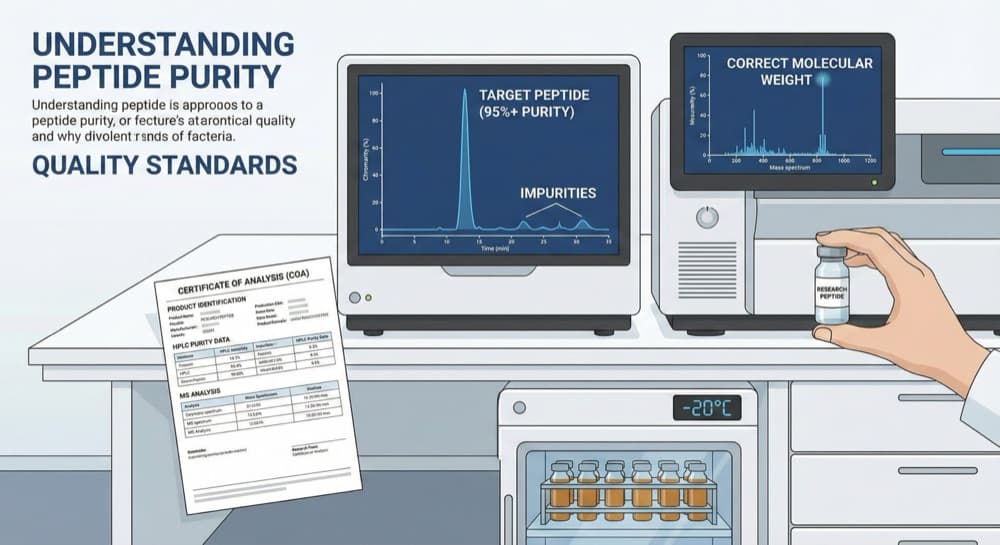
Peptide purity refers to the percentage of the target peptide in a sample relative to impurities. Research-grade peptides typically have purities of 95% or higher, with premium grades reaching 99%+.
Common Impurities
- **Deletion sequences**: Peptides missing one or more amino acids
- **Truncated sequences**: Incomplete synthesis products
- **Racemized amino acids**: Wrong stereochemistry
- **Side reactions**: Chemical modifications during synthesis
Testing Methods
High-Performance Liquid Chromatography (HPLC)
HPLC is the gold standard for peptide purity analysis. It separates compounds based on their chemical properties, allowing precise quantification of the target peptide.
What HPLC Tells You:
- Overall purity percentage
- Presence of related impurities
- Retention time for identification
Mass Spectrometry (MS)
Mass spectrometry confirms the molecular identity of peptides by measuring their mass-to-charge ratio.
Benefits of MS Analysis:
- Confirms correct molecular weight
- Identifies structural modifications
- Detects sequence errors
Certificate of Analysis (COA)
A legitimate COA should include:
- **Product identification** - Name, lot number, synthesis date
- **Purity data** - HPLC chromatogram and percentage
- **MS data** - Expected vs. observed mass
- **Appearance** - Physical description
- **Solubility** - Recommended solvents
Storage Considerations
Proper storage is essential for maintaining peptide integrity:
- **Temperature**: Most peptides require -4°F or colder
- **Light protection**: Store in amber vials or dark conditions
- **Moisture**: Use desiccants and sealed containers
- **Reconstitution**: Use appropriate sterile solvents
Quality Indicators
When evaluating a peptide supplier, consider:
- Third-party testing availability
- Batch-specific COAs
- Transparent manufacturing processes
- Proper cold-chain shipping
- Consistent lot-to-lot quality
Remember: Quality peptides are essential for valid research. Always verify purity before beginning experiments.