

Laboratory9 min read
Peptide Storage and Handling Best Practices
By Laboratory Team•
Peptide Storage and Handling Best Practices
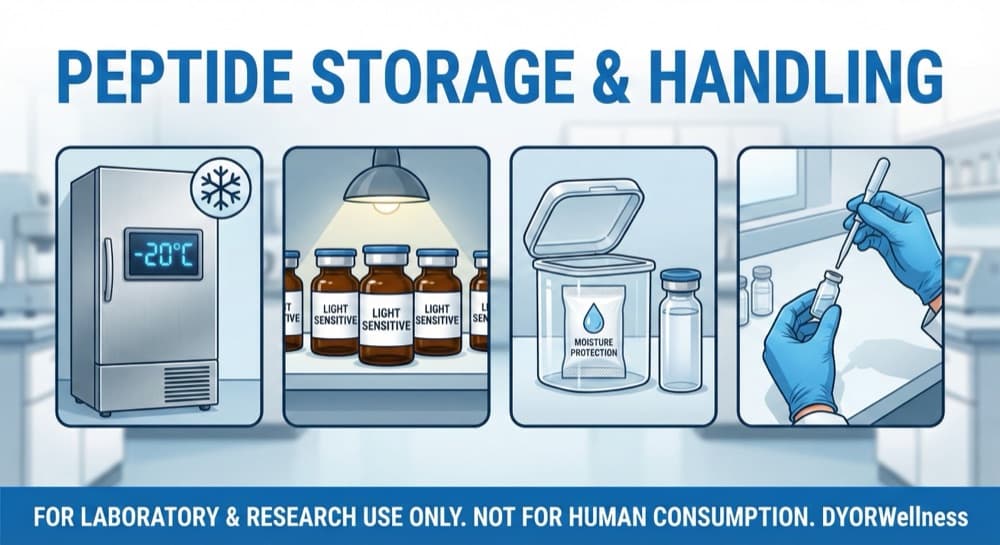
Proper storage and handling of research peptides is crucial for maintaining their stability and ensuring reproducible experimental results. This guide covers essential practices for peptide management in the laboratory.
Storage Fundamentals
Temperature Requirements
Lyophilized (Powder) Peptides:
- Short-term (< 1 month): 39°F (refrigerator)
- Long-term: -4°F to -112°F (freezer)
- Avoid repeated freeze-thaw cycles
Reconstituted Peptides:
- Store at 39°F for short-term use (days to weeks)
- Aliquot and freeze at -4°F for longer storage
- Never refreeze thawed aliquots
Environmental Factors
Light Protection:
- Store in amber vials or wrap in foil
- Minimize exposure during handling
- Some peptides are particularly photosensitive
Moisture Control:
- Keep lyophilized peptides in sealed containers
- Use desiccants when appropriate
- Allow vials to reach room temperature before opening
Reconstitution Guidelines
Choosing the Right Solvent
| Solvent | Best For | Considerations |
|---|---|---|
| Sterile Water | Hydrophilic peptides | Most common choice |
| Bacteriostatic Water | Extended storage | Contains preservative |
| Dilute Acetic Acid | Basic peptides | Improves solubility |
| DMSO | Hydrophobic peptides | May affect activity |
Reconstitution Procedure
- Calculate the desired concentration
- Allow vial to equilibrate to room temperature
- Add solvent slowly along the vial wall
- Gently swirl - never vortex or shake vigorously
- Allow complete dissolution before use
- Filter if particulates are present
Handling Precautions
Contamination Prevention
- Work in a clean environment (laminar flow hood when possible)
- Use sterile technique throughout
- Wear appropriate PPE (gloves, lab coat)
- Use fresh, sterile syringes and needles
Documentation
Maintain detailed records of:
- Lot numbers and COA information
- Reconstitution date and concentration
- Storage conditions and locations
- Aliquot tracking
Stability Considerations
Factors affecting peptide stability:
- **Oxidation**: Methionine and cysteine residues are susceptible
- **Aggregation**: Can occur at high concentrations
- **Deamidation**: Asparagine and glutamine modifications
- **Hydrolysis**: Especially at extreme pH values
Quality Verification
Before using stored peptides:
- Check for visible changes (color, clarity, precipitates)
- Verify concentration if possible
- Consider periodic HPLC analysis for critical experiments
- Discard if stability is questionable
Remember: Proper handling ensures your research results are reliable and reproducible.